Which EcoWatch should you choose? Ida, Julia or Johanna
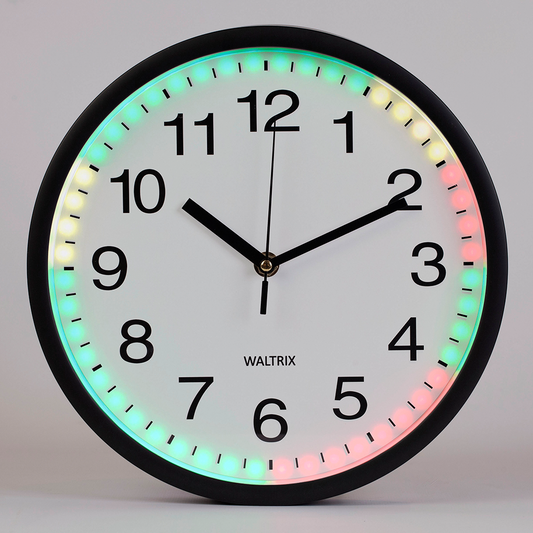
All three EcoWatch models do the same job: they show tomorrow's and today's electricity prices in colour, work in 18 price areas, control Shelly plugs and talk to Home Assistant. What differs is size, where they fit, how finely they show the price, and whether they have an inner ring. This guide helps you pick in five minutes.
The three models side by side
|
Ida |
Julia |
Johanna |
| Diameter |
16 cm |
25 cm |
40 cm |
| Placement |
Table stand or wall |
Wall |
Wall |
| Dial |
12-hour |
12-hour or 24-hour |
12-hour |
| Price resolution |
One LED per hour |
One LED per quarter hour (12 h) or two per hour (24 h) |
Six LEDs per hour |
| Hours ahead |
11 |
11 (12 h) or 23 (24 h) |
11 |
| Inner ring |
Yes, 12 LEDs |
Yes, 24 LEDs |
No |
| Live power with P1 meter |
Yes, inner ring |
Yes, inner ring |
No |
| Colours |
White or black |
White or black |
White dial, black frame |
| Readable from |
Across a desk |
Across a kitchen |
Across a living room |
| Price |
569 kr |
743 to 879 kr |
1 195 kr |
Pick by room
Kitchen or hallway, one clock for the whole household. Julia. It is the size of a normal kitchen clock, the quarter-hour resolution shows price changes clearly, and the inner ring gives you tariff hours or live power later if you want them. This is the model most people buy and the one reviewers tested.
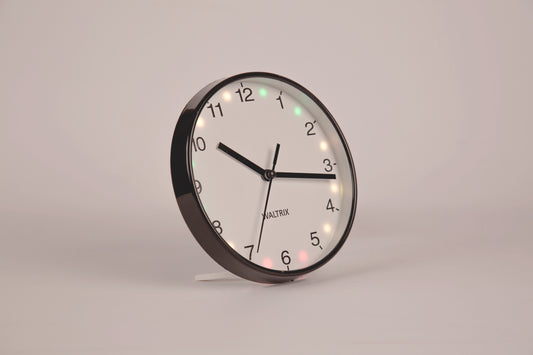
Home office, bedroom, student flat, or a second clock. Ida. Stands on a desk or shelf, hangs on a wall, costs the least. One LED per hour is enough to see the shape of the day.
Open-plan living room, workshop, school, office, shop. Johanna. At 40 cm with 72 LEDs it is readable from the sofa or across a classroom, and it looks like it was designed to be the only thing on that wall.
A gift. Julia in white, or the Limited Edition in Tärnsjö leather if you want something that will be talked about.
12-hour or 24-hour Julia?
The 12-hour dial reads like an ordinary clock and shows the current hour and the next eleven, with four LEDs per hour. Most households pick it.
The 24-hour dial shows the whole day at once with two LEDs per hour. Choose it if you plan ahead: "when tonight should the car charge", "is tomorrow morning cheaper than tonight". People who have had a 24-hour clock for a year tend not to go back. If you are unsure, 12-hour.
Do I need the inner ring?
Not at first. The inner ring (Ida and Julia) is where the optional things go: your grid company's tariff hours in orange, the day's green hours, or your home's live power use if you add the HomeWizard P1 meter. Johanna skips it in favour of one large, clean display. If live power display matters to you, choose Ida or Julia.
Accessories worth knowing about
What is in the box
The clock, a 2 m USB cable (USB-A to the clock's power connector), and a quick guide. The clockwork takes one AA battery (not included). No wall adapter.
Our recommendation in one line
Julia 12-hour for the kitchen; add an Ida for the office later; Johanna if the room is big enough to need it.
Questions people ask before buying
Does EcoWatch work where I live? In Sweden (SE1–SE4), Finland, Norway, Denmark, Germany, the Netherlands, Estonia, Latvia, Lithuania and France.
Do I need an app or a subscription? No. The clock fetches the prices itself over Wi-Fi, and settings are on a web page the clock serves on your home network.
Can I change the colours? Yes, all of them, including for colour blindness.
What does it cost to run? About 1 W, roughly 10 kronor a year.
What if I pick the wrong size? 14-day right of withdrawal, as with all our products. See the refund policy.
See all EcoWatch clocks